
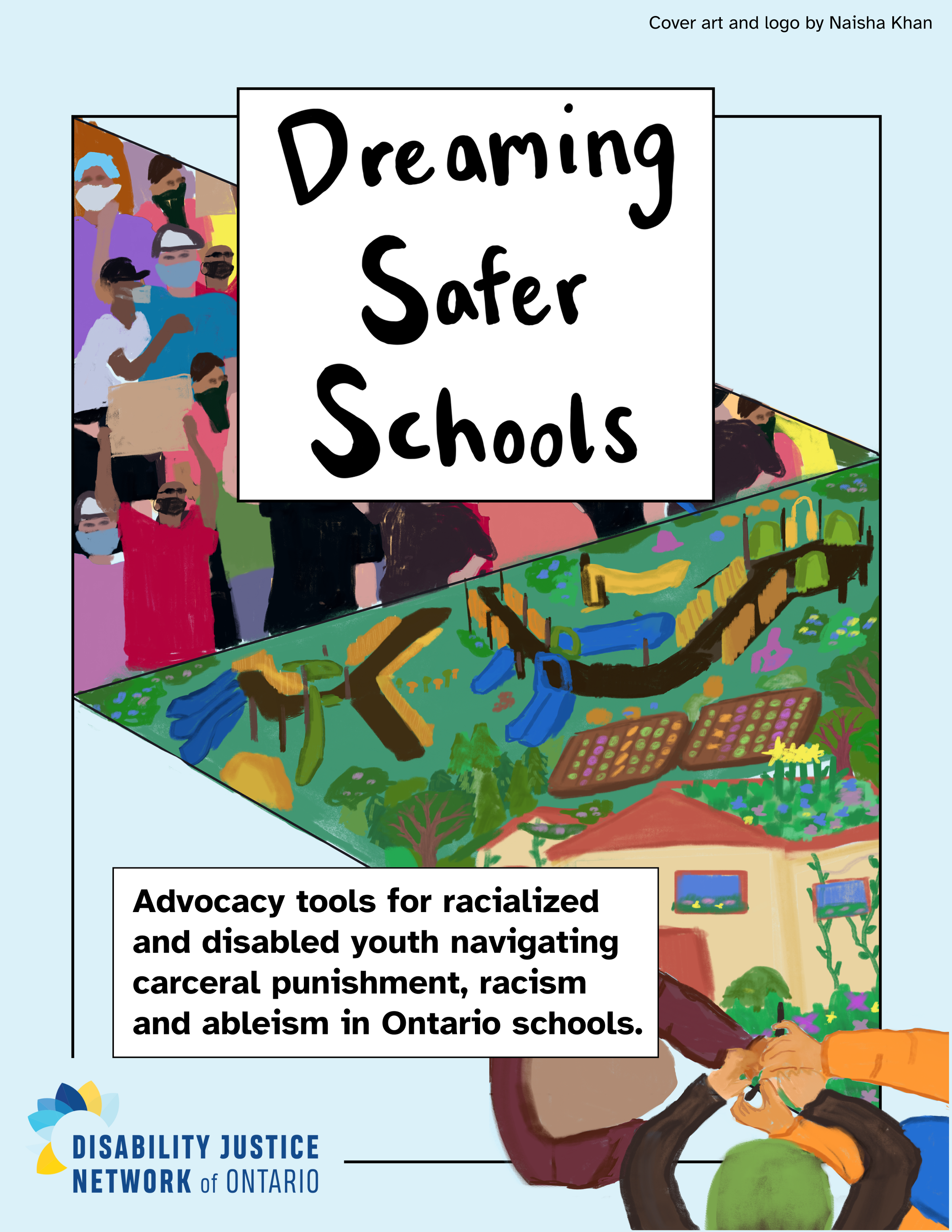
Advocacy tools for racialized & disabled students navigating unjust punishment in schools.
Funded by the Laidlaw Foundation, the Disability Justice Network of Ontario’s Dreaming Safer Schools Education Project aims to highlight the experiences of Black, Indigenous, racialized and newcomer disabled students within both the Ontario education system and the broader school-prison nexus. This project is built from consultations with community members, caregivers, community organizations and, most importantly, disabled youth.
We have created a toolkit with videos for self-guided education for disabled youth/families across Ontario. This toolkit includes a list of resources for disabled youth who are facing:
suspensions/expulsions;
exclusions;
physical restraint/seclusion;
shortened days;
surveillance/police violence;
and more.
You can access the toolkit in both online and printable formats.
DISCLAIMER
A Note on Language and Principles
The entirety of this toolkit is grounded in the fact that we do not support any form of carceral punishment in schools, including suspensions, expulsions, restraints, or any other policing practice that punishes, surveils, labels, or removes students from learning spaces. We also want to emphasize that we do not support segregated school spaces, such as behaviour units, seclusion/isolation rooms, or so-called “special education” tracks that remove disabled students, racialized students, or students labelled “disruptive” from inclusive education spaces. These forms of exclusion are rooted in ableism, white supremacy and carceral logics, and we know this.
Our work is abolitionist, which means we are fighting not only to remove police and punishment from schools, but to reimagine an education system where disabled youth are truly free to be.
We also reject carceral language pathologizes or criminalizes young people, especially those who are Black, Indigenous, racialized, disabled, poor, 2SLGBTQIA+, and/or otherwise marginalized. Throughout the videos, while you may notice some institutional language being used in reference to certain policies/legislation, this is because we are navigating systems that are still very much grounded in carceral logics (including the Education Act or school board policies) and thus, carceral language. While understanding this language is important to challenge these systems, we want to be clear: we at DJNO do not agree with this language, nor do we believe in what it represents.
Our commitments are grounded in the 10 Principles of Disability Justice, as brought forth by Sins Invalid. These principles remind us that our struggles are collective, that leadership must center those most impacted, that cross-movement solidarity is essential, and that all bodyminds are valuable.
We believe in education that is rooted in care, love, interdependence, healing and freedom—not fear, punishment or isolation.
We believe that the hard work of dreaming safer schools is essential, and we know that we keep us safe.